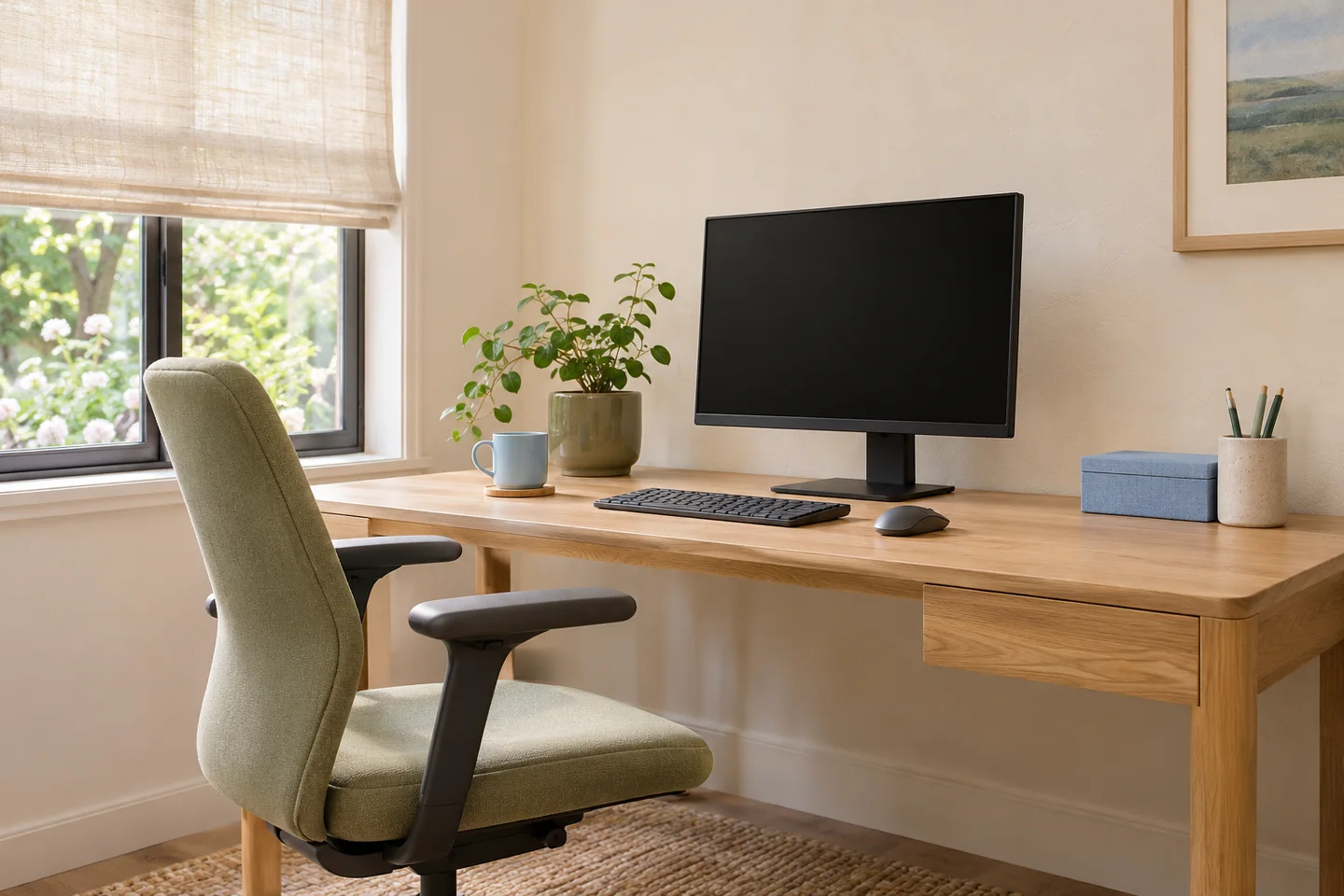
The short version
- Sit about 25 inches from the screen, right about at arm's length.
- Position the screen so your eyes gaze slightly downward.
- Match brightness to the room, cut glare, and make small text bigger.
Distance and height
The American Academy of Ophthalmology says to sit about 25 inches from the screen and position it so your eye gazes slightly downward, not straight ahead or up. The American Optometric Association gives a similar range: 20 to 28 inches from the eyes, with the screen 15 to 20 degrees below eye level.
Move the glare
A bright window or overhead light reflected in your screen makes it harder to see. The American Optometric Association suggests positioning the screen to avoid glare, particularly from overhead lighting or windows, and using blinds or drapes. The Academy suggests a matte screen filter. Keeping the screen clean helps too.
Match your screen to the room
If your screen glows brighter than your surroundings, your eyes have to work harder to see, says the Academy. Adjust the brightness to match the light around you, and try increasing the contrast.
Make the text bigger
Cleveland Clinic suggests zooming in if screen text is smaller than size 12, and reading dark print on a light background. If you notice yourself leaning in or squinting, that is a good moment to change it.
Other fixes from the Academy
- Blink on purpose and keep artificial tears handy
- Consider a humidifier in a dry, warm room
- Look up and into the distance regularly
- If you work at a computer for many hours, ask about computer eyeglasses, which are not the same as blue light blocking glasses

EyeBreak: Eye Strain & Care
A good setup still needs breaks. Our app runs a timer while you work and reminds you to look away.
We make this app, so we are not a neutral source. Free download with in-app purchases. Requires iOS 16 or later. The comparison shows two other approaches, so you can choose for yourself.
When to see an eye doctor
Screen habits are about comfort. They do not replace an eye exam, and they cannot tell you why your eyes hurt.
The American Academy of Ophthalmology says to see your ophthalmologist if:
- your eyes are consistently red, blurry or watery
- your eyes become sensitive to light
- your eyes are painful
This article is general information, not medical advice or a diagnosis.